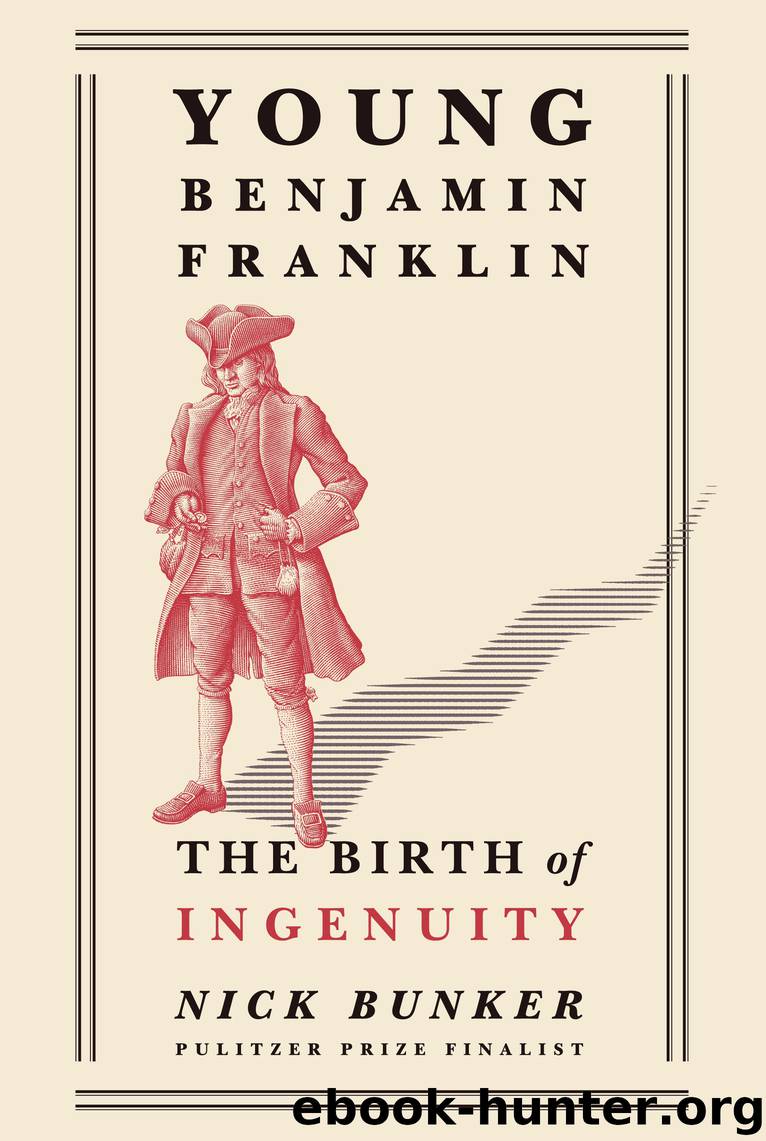
Young Benjamin Franklin by Nick Bunker
Author:Nick Bunker
Language: eng
Format: epub
Publisher: Knopf Doubleday Publishing Group
Published: 2018-09-17T16:00:00+00:00
THE BUSY-BODY
Franklin began by throwing in his lot with Andrew Bradford. The latter was still fighting the war of the almanacs against Samuel Keimer. And so he was very receptive when Franklin and his Junto friend Joseph Breintnall came forward with a series of columns for The American Weekly Mercury. Appearing over the byline of The Busy-Body, they were intended to make Mr. Keimer’s new Gazette look foolish and inferior. The columns were composed as stylishly as possible, because—as Franklin knew from Boston—elegance in prose was a sign of gentility. They wanted to make it plain that this was a quality they possessed and the Gazette did not.
The shaggy Mr. Keimer had done something that left him exposed to scandal. As he printed his extracts from the encyclopedia, starting with the letter A, he soon came to “Abortion.” Printing such a piece was not the way “to please all and offend none,” as Keimer had promised he would do. Franklin seized his opportunity. He wrote two letters to the Mercury, purporting to come from Martha Careful and Celia Shortface, two ladies most upset by such material. While Miss Careful threatened to pull Keimer’s beard, Miss Shortface took an oath to box his ears if there were any repetition.
And then on February 1 the Busy-Body series began. Seven years on from Silence Dogood, Franklin had become a still more expert writer in the manner of The Spectator. Cleansed of vulgarity, his diction was wide but always polite, his grammar was flawless, and his flowing syntax did what syntax should, always drawing the reader forward, making the columns immensely easy to read. Franklin quoted Alexander Pope and Latin poets too, Horace and Virgil; and although he intended to kill Mr. Keimer’s Gazette, he did the job with wit, not acrimony.4
The best of the series was a lively sketch about a single woman with a shop. Was he thinking of Sarah Read, Mrs. Holt, or Mrs. T the milliner? Whatever his source, Franklin shows us a woman beset by awkward customers who run amok amid her wares. The columns were done with a light, entertaining touch, so as to disarm any critics. When Franklin called Keimer “a sowre philosopher” and labeled the Gazette a “book of crudities,” his opponent could only look absurd by replying with clumsy insults. Keimer tried to make fun of Franklin’s lack of money and the threadbare coat he wore, but Franklin dealt with this by creating a character called Cato. He is a poor but honest farmer who personifies the patriotic virtues of the Romans, transplanted to the colonies.
Poverty is not a sin, says Franklin. In the Busy-Body items, he chiefly intended to undermine Keimer’s new venture: that was why Bradford wanted them for the Mercury. But apart from wrecking the sales of the Gazette, he had other things he wished to discuss. Politics, above all; in the shape of Cato, we can see Franklin sketching out a political philosophy of his own, with economics at its heart.
Download
This site does not store any files on its server. We only index and link to content provided by other sites. Please contact the content providers to delete copyright contents if any and email us, we'll remove relevant links or contents immediately.
| Africa | Americas |
| Arctic & Antarctica | Asia |
| Australia & Oceania | Europe |
| Middle East | Russia |
| United States | World |
| Ancient Civilizations | Military |
| Historical Study & Educational Resources |
Cat's cradle by Kurt Vonnegut(15362)
Pimp by Iceberg Slim(14519)
4 3 2 1: A Novel by Paul Auster(12398)
Underground: A Human History of the Worlds Beneath Our Feet by Will Hunt(12100)
The Radium Girls by Kate Moore(12033)
Wiseguy by Nicholas Pileggi(5791)
The Fire Next Time by James Baldwin(5452)
Perfect Rhythm by Jae(5409)
American History Stories, Volume III (Yesterday's Classics) by Pratt Mara L(5310)
Paper Towns by Green John(5194)
Pale Blue Dot by Carl Sagan(5012)
A Higher Loyalty: Truth, Lies, and Leadership by James Comey(4965)
The Mayflower and the Pilgrims' New World by Nathaniel Philbrick(4506)
The Doomsday Machine by Daniel Ellsberg(4492)
Killers of the Flower Moon: The Osage Murders and the Birth of the FBI by David Grann(4449)
The Sympathizer by Viet Thanh Nguyen(4396)
Too Much and Not the Mood by Durga Chew-Bose(4349)
The Borden Murders by Sarah Miller(4329)
Sticky Fingers by Joe Hagan(4204)
